Live
فارسی عربي
252
-
Aa
+

Iranian cartoons review US failures in Strait of Hormuz

Iranian caricaturist compares US military presence in the Persian Gulf during the presidencies of Ronald Reagan and Donald Trump.

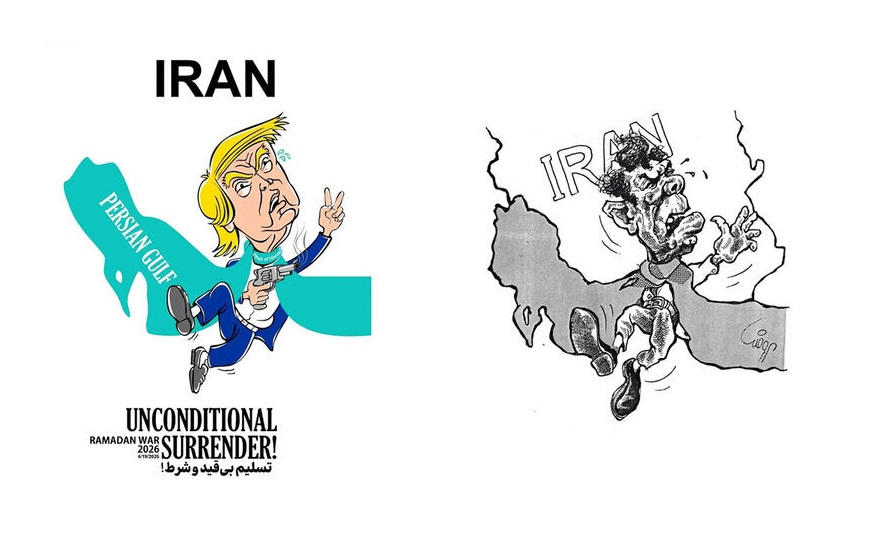
Iranian caricaturist Mohammad-Hossein Niroumand has compared US military presence in the Persian Gulf during the presidencies of Ronald Reagan and Donald Trump.

The artist published a new cartoon about Trump’s impasse in the Strait of Hormuz and compared it to an older one published by an Iranian newspaper some decades ago.

“It seems that time repeats itself. I designed an illustration back then for Reagan’s ominous presence in the Persian Gulf, which was printed in Keihan [newspaper]. Then, the issue of closing the Strait of Hormuz was raised as well. But today, Donald Trump is truly trapped in the Strait,” Niroumand wrote.

When the Tanker War escalated in 1987 in the Persian Gulf, Kuwait asked the US to escort its oil tankers. On August 22, 1987, the first convoy of escorted tankers, ordered by Ronald Reagan, began its mission to escort two Kuwaiti vessels along a 600 mile route. One of the tankers to be escorted, the Kuwaiti ship Bridgeton, which sailed under the US flag, struck a naval mine near Kuwait.

“I drew this cartoon during those days about Ronald Reagan’s entry into the Iraq–Iran War’s oil-tanker conflict, and it was published in Keihan [newspaper],” the caricaturist added.

The Tanker War was a major phase of the Iraq–Iran War (1980–1988). It involved both Iran and Iraq attacking oil tankers and merchant ships in the Persian Gulf and Strait of Hormuz to disrupt each other’s oil exports.

After some four decades, the strait has become the center of attention again in another conflict.

The US and Israel attacked Iran on February 28. Shortly after the war began, Iran successfully asserted control over the Strait of Hormuz, one of the world’s most critical energy chokepoints.

On April 13, Donald Trump imposed a naval blockade on Iranian ports in an effort to force Tehran to reopen the strait. However, Iran has adopted a firm stance on keeping it closed.

Trump’s decisions have drawn fierce criticism at home and abroad, with many warning it risks igniting a broader regional crisis and destabilizing the global economy.

Comments
Send