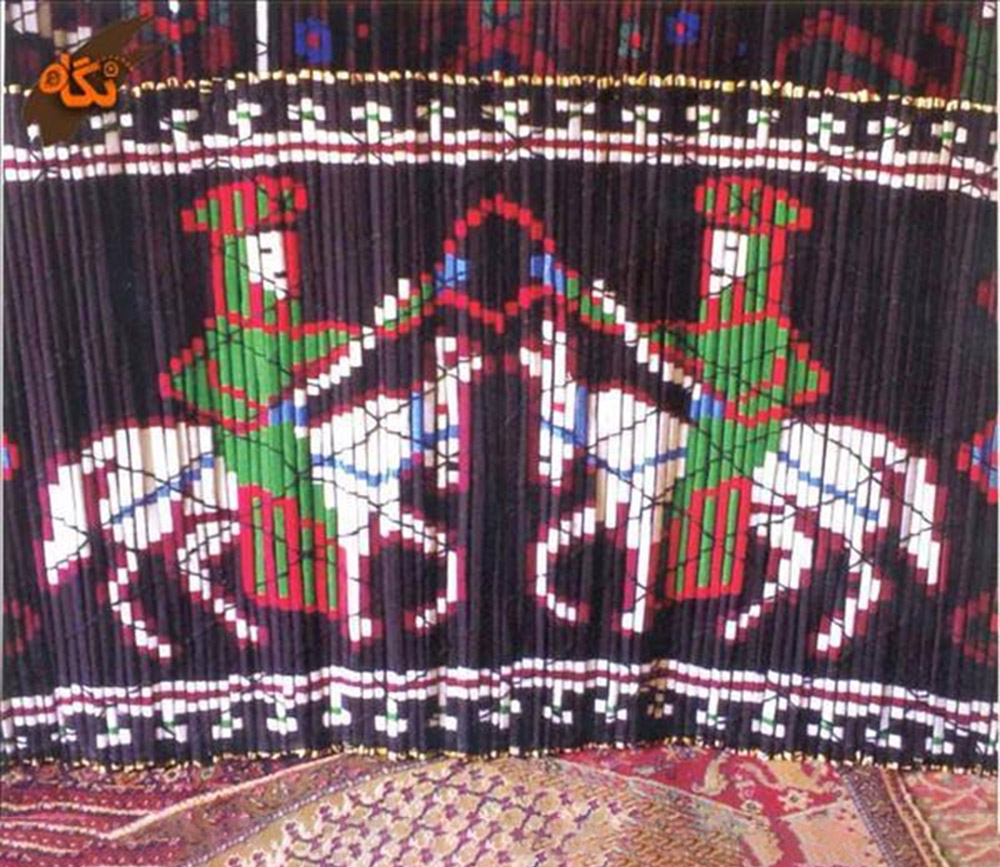
Chigh is woven using a kind of hollow reed and hair goat that is produced from the herd of the nomads.
The reeds, which grow wildly in the natural habitat of the nomads, are woven together by the spun wool yarn that is usually colorful.


The nomads in Iran as tent-dwellers have long been using Chigh as the covering of their tent walls to prevent heat, cold, wind, and dust from entering to the internal space.
When the weather is rainy and cold, the humidity adds to the volume of the reeds and makes them attach together to prevent the cold. But, when the weather is hot and dry, the reeds shrink and leave spaces for the air to pass through.


Besides, the hair goat used in weaving Chigh has two interesting characteristics: 1) it produces a strong shade which makes a Chigh an ideal awning and 2) it is a natural repeller of insects and snakes.
Nowadays, considering the fact that the distance between the reeds used to weave Chigh is adjustable, this product can also be used as shutters, dividers, wall coverings, and decorations that can also be hanged in front of the entrance door in urban houses.
Chigh is a Turkish word; and, in different regions of Iran, it is known with different names such as Alaghigh, Chikh, Chit, and Chig.


More stories on Persian handicrafts:
A unique tribal journey to discover another face of Iran
A glimpse into the art of Pan Bafi in Alamut
Forgotten craft of Kiseh-bafi in Chaharmahal & Bakhtiari Province
800-year-old art of Darayi-Bafi in Yazd Province: Persian handicraft
Neglected craft of Aba-bafi in western Iran
Khorjin-Bafi: Regional Persian handicraft
MM/FM